Showing posts with label Regional Parks. Show all posts

July 14, 2011

Foggy Days of Summer . . .


June was a mix of misty, foggy days and bright blue sunny skies with a bit of rain . . .


We collected a fair amount of beach trash so far this summer. Lots of full doggie-do bags that I didn't pick up . . .


~~~~~~~~~~~~~~~~~~~~~~~~~~~~~~~~~~


There are only a handful of films that I've seen in my life that have moved and inspired me. Having only viewed the trailer, I am certain 'Midway' will be one of those movies I will never forget . . . 

~~~~~~~~~~~~~~~~~~~~~~~~~~~~~~~~~~
Michael Fishbach narrates his encounter with a humpback whale entangled in a fishing net. This well done video captures the final release of the whale who graced it's saviors with quite a show of breaching and tail slapping!  Fishbach and Gershon Cohen founded The Great Whale Conservancy to help and protect whales.


The Great Whale Conservancy (GWC) is a joint program of two premier projects of the Earth Island Institute: the International Marine Mammal Project and the Campaign to Safeguard America’s Waters. Their focus is "to protect blue whales along the Californa coast from ship-strike caused injuries and death." The blue whale is the largest animal species to have ever inhabited the Earth. The global population prior to human predation has been estimated at 350,000 individuals. Today that number is ~10,000.  For more information click on The Great Whale Conservancy (GWC).  

Thank you to sister Kimberly for sending this my way . . . xxoo

Sparkling clear blue skies

June 11, 2011

Stars of the Sea . . .

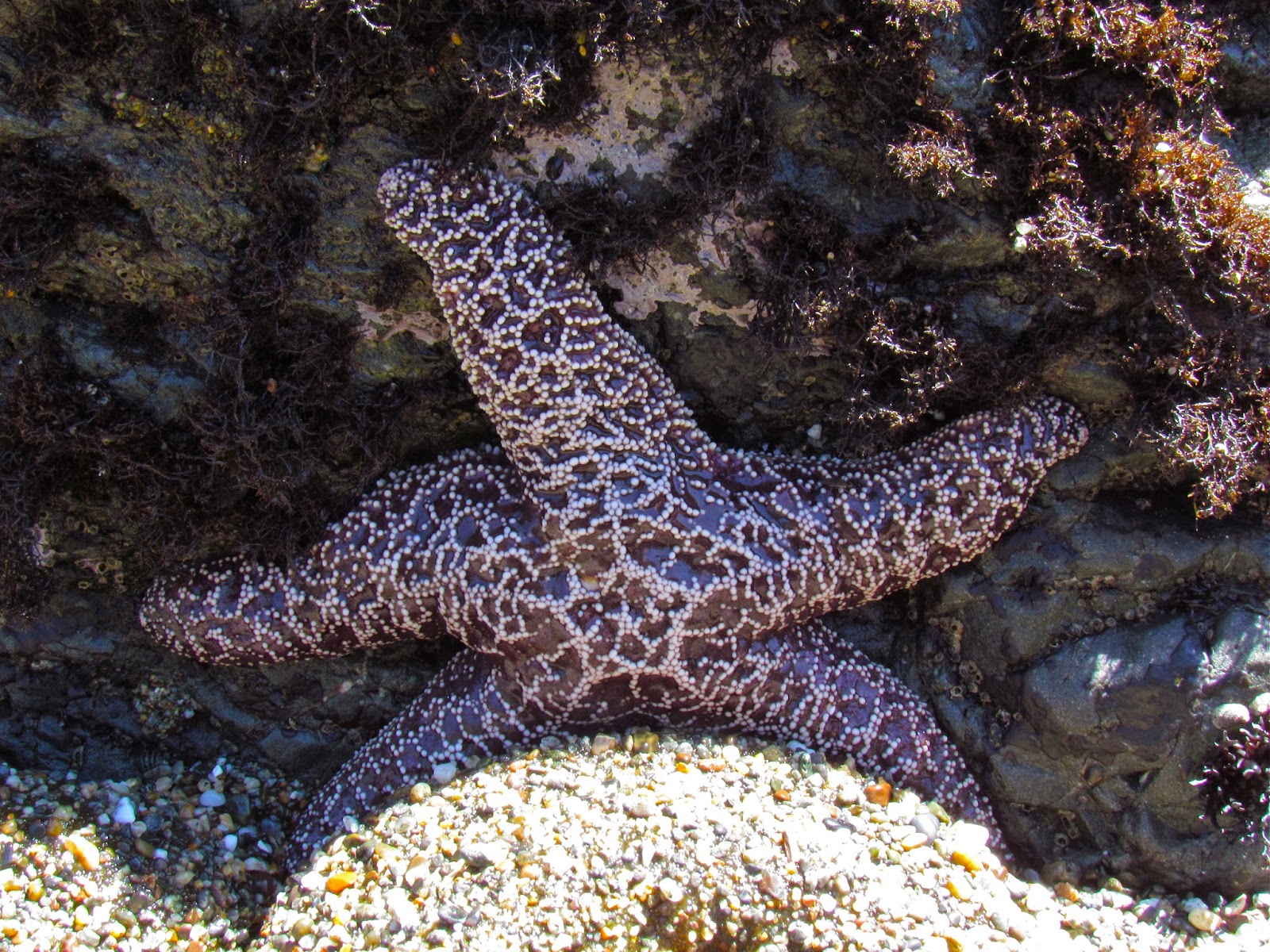
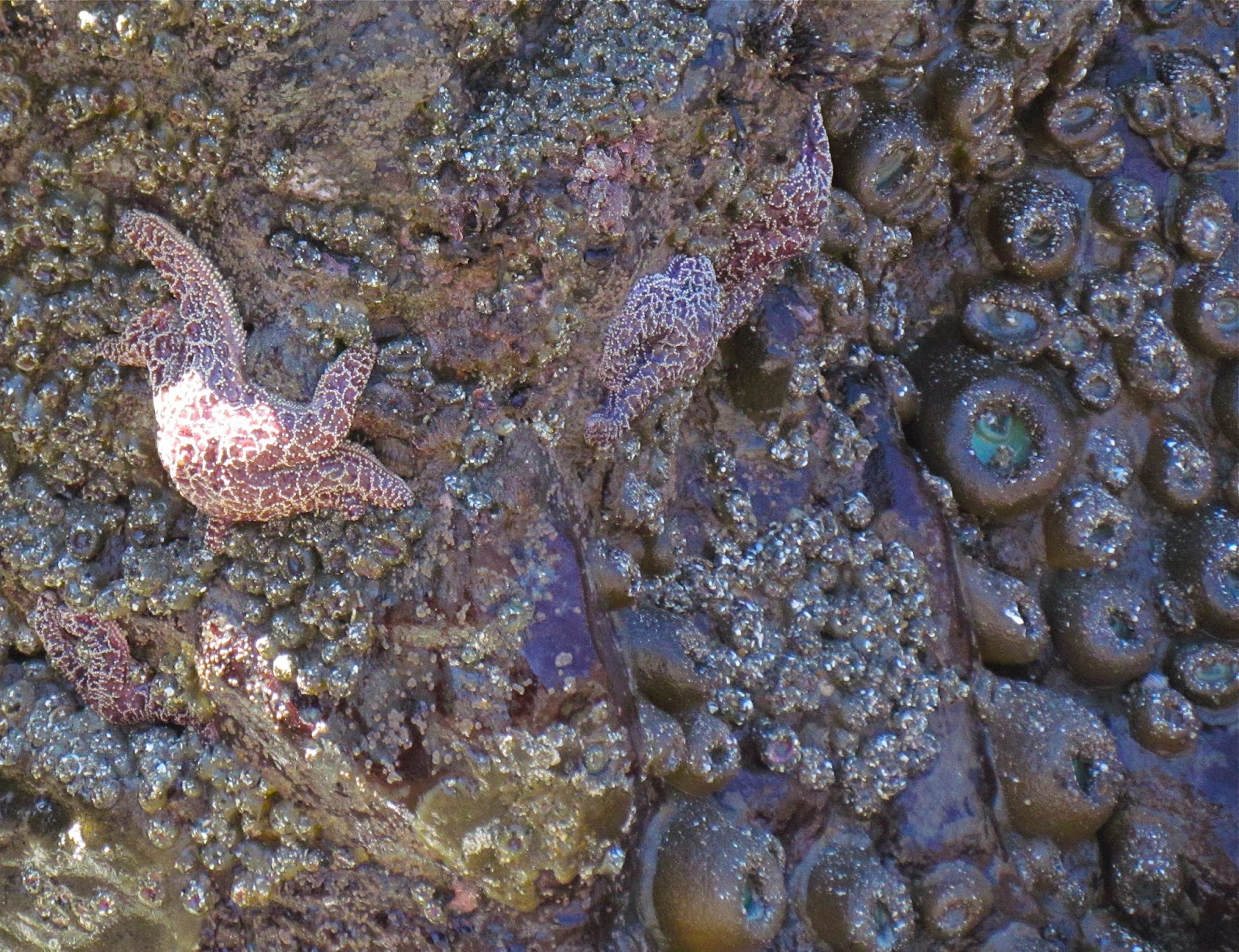
Sea Stars on Doran Beach

My cousin, Lauri, lives in Alaska. She's a California native who moved to Alaska over 25 years ago. Her lifestyle fits her self-reliant nature perfectly. Lauri lives by the sea and walks the beach nearly every day photographing Alaskan sea life and wildlife. She is compelled to know about her surroundings and the creatures that inhabit her shared haven. After reading my last post, Lauri brought to my attention that 'sea star' is the correct name for what I mistakenly identified as 'star fish'. 

I grew up calling these invertebrates 'star fish' and just about everyone I know does the same. So I was compelled to find out why the name change and learned so much more on Buzzle.com:

Doran Beach

Facts about Sea Star

Sea stars are echinoderms that exhibit radial symmetry and possess tube feet for locomotion. These marine creatures, though often called Starfish, are not fish. They lack blood and brain, and have two stomachs for digestion. They even possess the unique ability to regenerate their lost arms…


Sea stars are star-shaped invertebrates living on the rocky sea floor. There are about 1800 known living sea star species that are distributed across the globe. The greatest variety of these are found in the tropical Indo-Pacific. Some other regions where they are widely found are the temperate regions of Australia, the cold-temperate waters of the North Pacific (California to Alaska), and the tropical East Pacific regions. These marine creatures can be sized from ½ an inch to over 3 feet in diameter and can live up to 35 years. Leather Star, Vermilion sea stars and Cushion stars are some of the common sea stars along the Pacific coast.


Sea stars are not fish

Sea stars are often referred to as starfish, however, the point to be noted is that the sea star is not a fish, which is why marine scientists have preferred to change its name from starfish to sea star. Sea stars and fish come under Kingdom
Animalia. However, since fish are vertebrates, they belong to phylum Chordata, and sea stars along with sea urchins, brittle stars, feather stars and sea cucumbers come under phylum Echinodermata. Echinoderms exhibit a radial symmetry, which means that their arms radiate from a central disk outwards. Echinoderms are also characterized by tube feet, an endoskeleton that is made up of ossicles and plates in their body wall (may be large or microscopic). 


Click Here to Learn More About the 'Sea Star' on Buzzle.com 


“People protect what they love”          
                    Jacques~Yves Cousteau


photo, Darris B. Nelson


The Unseen Costs of Pollution . . .

Suja Lowenthal is an enormous asset to her city and an inspiring activist for our oceans. I was so moved by Long Beach Vice Mayor, Suja Lowenthal's passionate presentation I wanted to share it with you . . .


Vice Mayor of Long Beach, CA Suja Lowenthal, discusses the growing economic costs of collection and disposal of plastic – the externalized costs of plastic pollution.

"Change starts with each of us" 
                                    Suja Lowenthal

Fact:
The true cost of cleaning up garbage: 
  • 2.2 million dollars to clean up Long Beach coastline. 
  • 20 million dollars invested in cleaning up pollution just in Long Beach alone.


Low tech trash clean-up: Catch Basin Debris Diverters ~ ‘Treatment Train'. Helps to keep trash out of our oceans.


"Cleaning up pollution is a very lonely endeavor."
                                    Suja Lowenthal

Fabian Cousteau TEDxGreatPacificGarbagePatch


Talking Points from Fabian Cousteau's TED talk:

  • Oceans ~ our life support system . . . our world’s circulatory system
  • oceans encompass 99% of our worlds total biodiversity
  • they house almost 95% of the worlds life
  • 80% of garbage in the ocean comes from land-based sources, mostly single-use plastic
  • creating a ‘plastic soup’.
  • There is a gyre in every ocean
  • 2.4 million pounds of plastic is dumped into our ocean every HOUR!
  • We are losing 1 million apex predators every year just to plastics

“People protect what they love”   Jacques~Yves Cousteau


One thing you can do today to stop the flow of plastic into our oceans is to STOP BUYING ALL SINGLE USE PLASTIC.


REDUCE, REUSE, recycle . . .

~~~~~~~~~~~~~~~~~~~~~~~~~~~~~~~~~~~~~~~~~
fog under the Golden Gate ~ photo, Darris B. Nelson
trash picker ~ photo, Darris B. Nelson
S.F. night sky ~ photo, Darris B. Nelson


Researchers have discovered a rare white porpoise in the San Francisco Bay.
ABC video of rare white porpoise in S.F. Bay


The discovery is thrilling environmentalists, who were already excited to see any harbor porpoises coming back after they disappeared decades ago.


On any given day, dozens of harbor porpoises are swimming right under the Golden Gate Bridge. 

Bill Keener knows many of them by sight. In the last two and a half years Keener and a team of observers have photographed more than 200 individual porpoises. 

link: Golden Gate Cetacean Research

The porpoises do not have names, but they do have code numbers. There's handsome SFB 78 with a rugged scar, the dutiful mother SFB 34 with her jet black calf and SFB 179, whose tail may have been bitten by a shark. Harbor porpoises are about five feet long, roughly half the size of a dolphin. They lived in the San Francisco Bay for thousands of years. But in World War II, the military strung a net across the Golden Gate Bridge and placed mines around the entrance. They were blocking enemy submarines, but the porpoises were blocked too. 
The nets and mines were eventually removed, but as the bay got more polluted, the porpoises did not come back. That is until 2008, when Keener's colleague first spotted some near Sausalito. 

"It was very exciting," Keener said. "And it wasn't just one animal, it was mothers with calves, so we knew there's family groups, and they are coming in to feed." 

Keener is an environmental lawyer and former head of the Marine Mammal Center. He and a handful of other experts now have a permit to study porpoises and figure out why they would return to an urban waterway full of boat traffic. 

"It could be the bay is cleaner and there are more fish," Keener said. "The bay is in a particularly productive period right now and that's very good and to have naturally animals come back into an area is pretty unusual." And even more unusual was a photograph Keener took April 30 of a rare white porpoise. 

"It appears to be the very first white harbor porpoise ever recorded from the Pacific Ocean," Keener said. 

In the last 100 years scientists have only documented six other white harbor porpoises anywhere in the world. The team is hoping this one will come back. And if it does, it's likely to be visible again from the Golden Gate Bridge. 

"It's one of the best places in the world to do porpoise research because unlike going out on a boat where you disturb them by your very presence, they don't know you are on the bridge," Keener said.
Observers note the animals' scars and coloring to figure out who is who in the porpoise world. The porpoise photos reveal a rich social life with lots of interaction. 

Researchers believe one reason the animals are thriving is what is happening under water. Along the Northern California coast there are three marine sanctuaries protected by the federal government.
"All of the animals, including the corals on the bottom, the worms in the mud, as well as the porpoises, it all cascades into being more positive for a healthier environment for all the animals," Gulf of Farallones Marine Sanctuary spokesperson Jan Roletto said.
Casual observers can see some of that, including porpoises and a lot more, just by walking out on the Golden Gate Bridge.
"It's a fantastic platform to view wildlife and I think local people don't realize that," Keener said. 

Harbor porpoises have also appeared in other areas around the central part of San Francisco Bay. Anyone who sees one, either a porpoise or a dolphin, is asked to report it to the Cetacean Research Group. 

Written and produced by Jennifer Olney


http://abclocal.go.com/kgo/video?id=8139355

June 10, 2011

Blue Sway . . .


sea stars ~ photo, db Nelson
waiting for high tide . . . ~ photo, db Nelson
tide pooling ~ photographer, Barbara Denham

National Geographic ~ Bodega Bay Tidepools

'Brimming Pools' is a featured article in National Geographic this month. Along with beautiful photographs by David Liittschwager, writer Mel White takes us on a journey of Bodega Head Tidepoos. Guided by Sarah Ann Thompson, a marine biologist from the Farallon Institute in Petaluma, White describes his experience:

The rocks and pools here create an abundance of opportunities and host a diversity of life to rival any rain forest. Pisaster is just one of scores of species that have adapted to innumerable micro-habitats with a seemingly endless variety of physical shapes and lifestyles. One little worm can shoot a harpoon out of its head to stab its prey. A limpet tends and guards its own farm plot. A seaweed releases acid for defense when it's injured. A nudibranch (which looks like a gussied-up slug) eats poisonous creatures and implants stinging cells under its own skin to repel predators.
Why all the aggression? It's simply the result of lots of plants and animals competing for resources in a highly productive but limited space. In nature, as in real estate, location is everything, and the intertidal zone is Park Avenue.

White also gets an education about sea creatures from Erik Sanford, a biologist with the Bodega Marine Lab. White tells us:

So there's the magic. Eric Sanford is holding, in one hand, representatives of more than one-fourth of all the animal life on Earth: nine phyla on one rock. In comparison, the entire land surface of the planet, from Poles to Equator, is home to only about a dozen phyla.

Sanford is actually a little crestfallen because he can't find a peanut worm, an odd thing in the phylum Sipuncula that would give us an even ten. The thrill would have been strictly numerical, though. I've already seen a peanut worm, and it has all the aesthetic appeal of used chewing gum. (I must admit, however, that the one thing it does, it does very well: extending a hydraulically powered, tentacle-tipped proboscis several times the length of its body to grab tiny bits of drifting dead stuff. Sanford calls it "this crazy sort of Dr. Seuss-like thing.")

This article is a great way to learn a bit more about our precious and unique coast. For more information contact the Bodega Marine Lab for a tour. Public drop in tours are available Fridays, 2-4 for groups less than 10 people. 

Thank you to our own (future) Bodega Bay Veterinary Hospital for bringing this to our attention.


Previously Unreleased track, 'Blue Sway' Written Nearly 20 Years Ago Dedicated to Linda McCartney . . .


'Blue Sway' music video


Paul McCartney recruited award-winning surf filmmaker Jack McCoy to create a music video for his previously unreleased track "Blue Sway." Written nearly 20 years ago, McCartney's never-before released song, "Blue Sway," is available for the first time on the bonus audio disc of the special edition of McCartney II. The music video created by McCoy is also featured on the bonus DVD included in the set. McCartney II will be released on June 14th by MPL and Concord Music Group.

Jack McCoy has been capturing the surfing vision in a truly unique way. Using a high powered underwater jet ski, the filmmaker found that he was able to travel behind a wave, creating underwater images that have never been seen before.

Over the past couple of years, McCoy set out to capture footage for his surf film, A Deeper Shade of Blue. During the editing process, McCoy put one of his surfing sequences to a song off McCartney's The Fireman album. A mutual friend, Chris Thomas, saw the footage while visiting McCoy in Australia, and when he returned to the UK he gave McCartney a copy of the sequence.

"Paul was pretty stoked with what I'd created. He immediately thought my images might be suitable to go with his unreleased song "Blue Sway." said McCoy.

McCoy spent the next six weeks creating the music video, while also working full days on making A Deeper Shade of Blue. McCoy compiled and edited footage that he filmed off Tahiti's Teahupoo reef to create what became the "Blue Sway" video.

"When I saw Jack McCoy's underwater surfing footage put to the soundtrack of "Blue Sway" I was blown away," said McCartney.

"Blue Sway" won 'Best Music Video' at NYC BE FILM Short Festival this past May, and the video will be featured as part of Surfrider Foundation's summer PSA campaign. Surfrider Foundation is a non-profit grassroots organization dedicated to the protection and enjoyment of our world's oceans, waves and beaches.

For more information about the McCartney II : http://paulmccartney.com.
For more information on Jack McCoy's A Deeper Shade of Blue: http://adeepershadeofblue.com
For more information on Surfrider Foundation: http://surfrider.org.


Too amazing not to repost . . .


May 31, 2011

Midway . . . Hopeless Tragedy or Catylyst for Change . . .


Seeing these photographs of dead albatross full of plastic on Beth Terry's website, Fake Plastic Fish now called, My Plastic Free Life, changed my life forever. 

Chris Jordon, Photographer

Chris Jordon, Photographer


I would never again stroll on the beach without picking up trash. I would never again look at the tide break and mistake tiny pieces of plastic for sea life. I would never again buy something in plastic and feel OK about my purchase. 

I have lessened my use of plastic drastically but I have a long way to go to be plastic-free. As a matter of fact, it may never happen. Plastic is everywhere in my life. My printers, my telephone, my contact solution, the tags on my cats . . . even my camera. The list is endless. It may not be realistic for us to become truly 'plastic free' in our culture today but I do believe we can have a drastic impact just by being aware of the mess we've created thus far in the name of cheap and convenient.

If everyone of us picked up some trash every time we stepped outside it would make a difference. If everyone of us was intolerant of littering and it became an immense social stigma, it would make a difference. If everyone of us purchased an item in glass, or cardboard or something that is truly being recycled, instead of plastic, it would make a huge difference. If everyone of us was aware of the overwhelming destruction plastic has on our environment, we could make a difference.

Disconnect left lying on the beach . . .


Picturing Excess . . .
I added another video that Chris Jordon created for TED Talks. In this powerful 11 minute talk, Chris shows his photographs that represent 'excess' in our culture.


Chris gets his message of cultural excess and disconnect across beautifully using a universal language ~ pictures.  I don't see the need to expand too much here on his message as he has done such a beautiful job.


If you're enjoying this blog, consider leaving a comment, I'd love to hear from you via this blog . . . thanks! 


May 19, 2011

Bodega Bay Wildlife . . .

seals & gulls near Diekman's Market

I leapt out of the car to get this shot so it's not the best photo but captures something many people never see.


Doran Beach Castles and Kites Day . . .  


Castles and Kites entry ~ April 23, 2011 ~ Photo by Darris


Petaluma entry ~ Photo by Darris

twisted shark humor . . . ~ Photo by Darris
nose humor ~ Photo by Darris
Doran Beach Dragon ~ Castles and Kites Day ~ Photo by Darris


Valley Springs, CA sand artists ~ Photos by Darris
 
I didn't get a photograph (had ya there for a minute though didn't I!) but I spotted two breaching Orca whales just beyond the breaking waves. There were other whales swimming along with them, possibly Gray whales. Uncommon to see whales at all at Doran Beach but to see Orca's is rare indeed.

Orca ~ photo credit/National Geographic


Bobcat-Spring Lake ~ Thomas Reynolds, photographer
This bobcat wasn't photographed in Bodega Bay but it's such a great shot! These guys are roaming all over our coastal hills but are rarely seen. Wildlife photographer and park volunteer, Tom Reynolds, told me he and a friend spotted this bobcat off the trail at Spring Lake, sunning on a rock.


An avid bird-watcher and photographer, Tom is photographing wildlife all over Sonoma County everyday. He generously shares his photographs with me and frees me up to share them with you. 

Immature Great Horned Owl ~ Tom Reynolds, Photographer


Peregrine Falcon ~ Thomas Reynolds, photographer

April 12, 2011

A Love Letter to You . . .


I love this little eleven minute film about 30-something professionals and climbers, Fitz and Becca Cahall's 300 mile journey through the Sierra's. In my mind, they've got their priorities straight. Stunning photography, beautiful message . . . I love what Fitz does at the end of the film . . .

I am a 50-something hiker. All I want to do is hike and photograph and blog about hiking. I dream of hiking the Pacific Crest Trail . . . all of it. Not at once, pieces at a time. This is a goal worthy of living. Anytime spent in nature, in the out-of-doors, makes life worth living. Spending that time with the people I love makes my time hiking beyond amazing . . .


May 2010 Infineon Race


My kid feels this way about dirt biking.  I understand his passion for being outdoors on his bike, on the trail, challenging himself, feeling victorious, feeling alive, being with people he enjoys and with whom he can share his passion. I'm happy he has something he feels so exuberant about.  

As a teenager I felt that way when I was on the back of a horse, bicycling out to Stafford Lake, on the back of a motorcycle, or with my friends at the beach. I felt alive. I have no recollection of feeling this way indoors, it was always out-of-doors that I had aliveness flowing through me.

So I send you this post as my love letter to you . . . go outside, take a walk, a hike, a ride . . . enjoy being alive . . .

xxoo
 

CLICK HERE for VERTICULTURE ~ "What's Your Love Letter?" contest

March 14, 2011

Searching for Effects of the Tsunami . . .

Bodega Head looking North
on the trail

All was pretty calm. There was a 'surge' of water headed into the harbor that a friend described as sounding like "a whitewater river". The waves were coming in faster than usual it seemed.

'surge' into harbor ~ photo taken by Thomas Reynolds


Coast Guard with Seal Rock in background
Doran Beach was closed all day . . . looking calm

seal watching
Hole in the Head
trash on the trail . . .

Although all the beaches were closed we enjoyed our trail hike. It was a beautiful sunny day here on the coast. 

My heart goes out to the people in Japan who are suffering devastating loss . . . .


Bodega Head