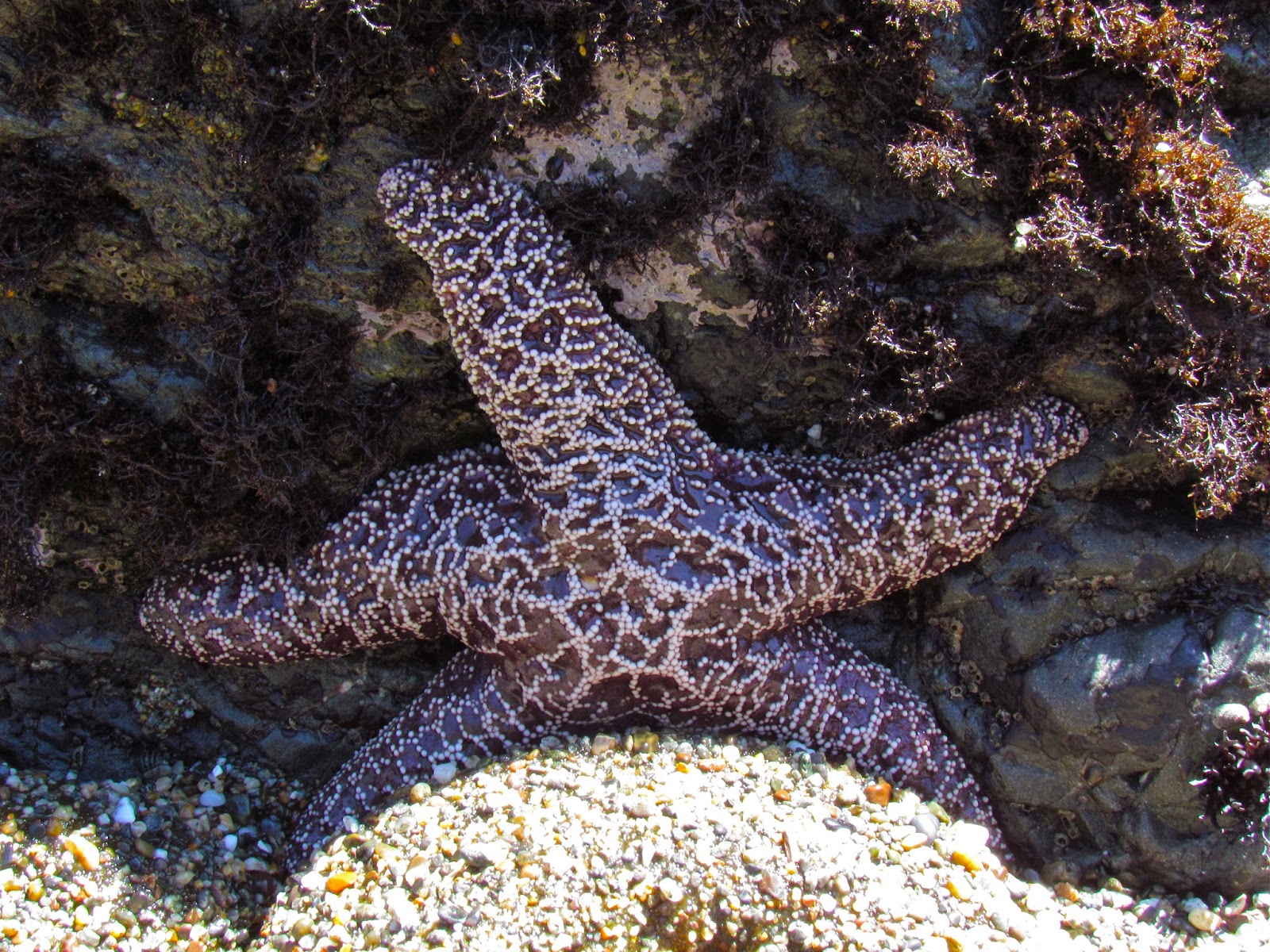
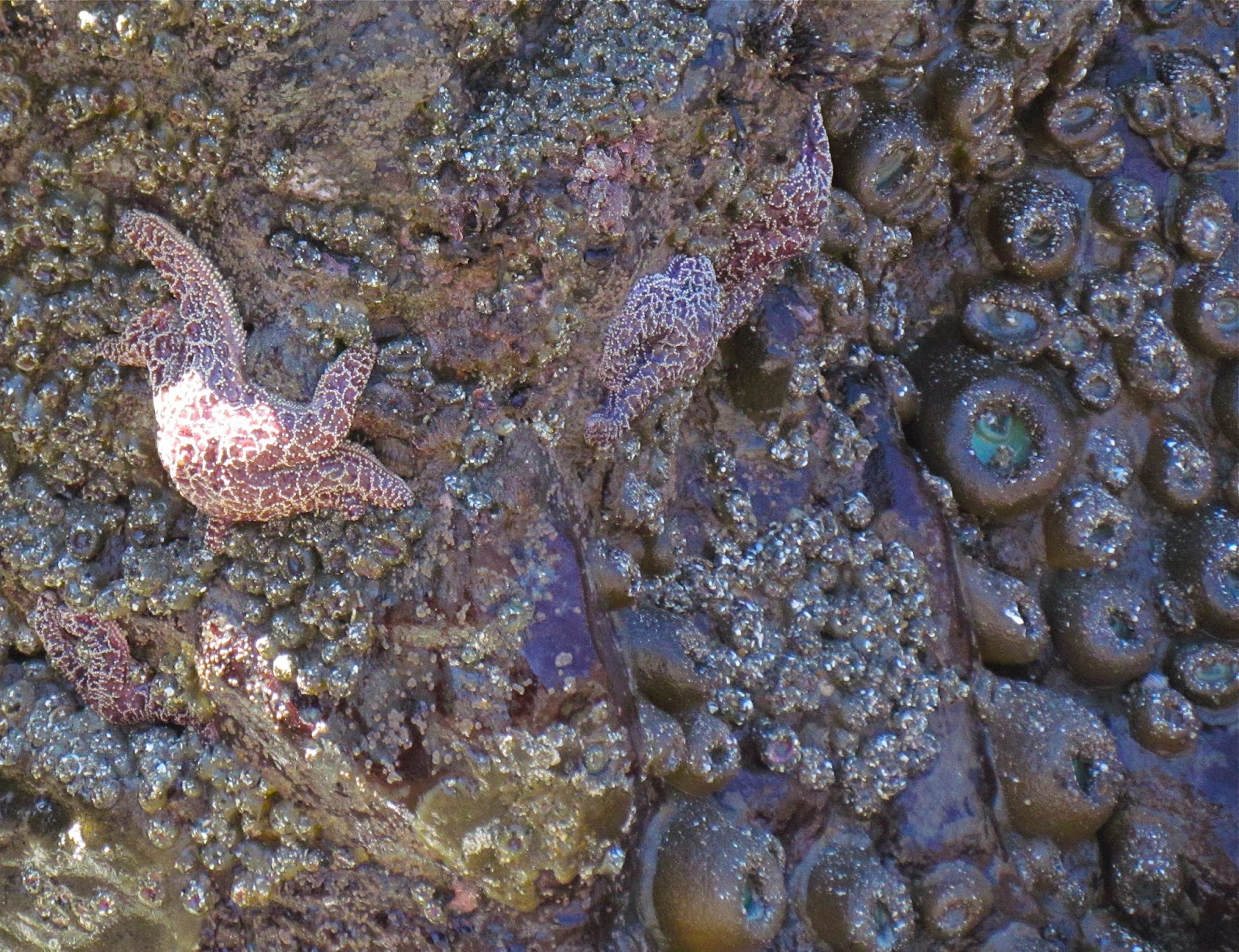
My cousin, Lauri, lives in Alaska. She's a California native who moved to Alaska over 25 years ago. Her lifestyle fits her self-reliant nature perfectly. Lauri lives by the sea and walks the beach nearly every day photographing Alaskan sea life and wildlife. She is compelled to know about her surroundings and the creatures that inhabit her shared haven. After reading my last post, Lauri brought to my attention that 'sea star' is the correct name for what I mistakenly identified as 'star fish'.
I grew up calling these invertebrates 'star fish' and just about everyone I know does the same. So I was compelled to find out why the name change and learned so much more on Buzzle.com:
Doran Beach
Facts about Sea Star
Sea stars are echinoderms that exhibit radial symmetry and possess tube feet for locomotion. These marine creatures, though often called Starfish, are not fish. They lack blood and brain, and have two stomachs for digestion. They even possess the unique ability to regenerate their lost arms…
Sea stars are star-shaped invertebrates living on the rocky sea floor. There are about 1800 known living sea star species that are distributed across the globe. The greatest variety of these are found in the tropical Indo-Pacific. Some other regions where they are widely found are the temperate regions of Australia, the cold-temperate waters of the North Pacific (California to Alaska), and the tropical East Pacific regions. These marine creatures can be sized from ½ an inch to over 3 feet in diameter and can live up to 35 years. Leather Star, Vermilion sea stars and Cushion stars are some of the common sea stars along the Pacific coast.
Sea stars are not fish
Sea stars are often referred to as starfish, however, the point to be noted is that the sea star is not a fish, which is why marine scientists have preferred to change its name from starfish to sea star. Sea stars and fish come under Kingdom Animalia. However, since fish are vertebrates, they belong to phylum Chordata, and sea stars along with sea urchins, brittle stars, feather stars and sea cucumbers come under phylum Echinodermata. Echinoderms exhibit a radial symmetry, which means that their arms radiate from a central disk outwards. Echinoderms are also characterized by tube feet, an endoskeleton that is made up of ossicles and plates in their body wall (may be large or microscopic).
“People protect what they love” Jacques~Yves Cousteau
photo, Darris B. Nelson
The Unseen Costs of Pollution . . .
Suja Lowenthal is an enormous asset to her city and an inspiring activist for our oceans. I was so moved by Long Beach Vice Mayor, Suja Lowenthal's passionate presentation I wanted to share it with you . . .
Vice Mayor of Long Beach, CA Suja Lowenthal, discusses the growing economic costs of collection and disposal of plastic – the externalized costs of plastic pollution.
"Change starts with each of us" Suja Lowenthal Fact: The true cost of cleaning up garbage:
2.2 million dollars to clean up Long Beach coastline.
20 million dollars invested in cleaning up pollution just in Long Beach alone.
Low tech trash clean-up: Catch Basin Debris Diverters ~ ‘Treatment Train'. Helps to keep trash out of our oceans.
"Cleaning up pollution is a very lonely endeavor." Suja Lowenthal
The discovery is thrilling environmentalists, who were already excited to see any harbor porpoises coming back after they disappeared decades ago.
On any given day, dozens of harbor porpoises are swimming right under the Golden Gate Bridge.
Bill Keener knows many of them by sight. In the last two and a half years Keener and a team of observers have photographed more than 200 individual porpoises.
The porpoises do not have names, but they do have code numbers. There's handsome SFB 78 with a rugged scar, the dutiful mother SFB 34 with her jet black calf and SFB 179, whose tail may have been bitten by a shark. Harbor porpoises are about five feet long, roughly half the size of a dolphin. They lived in the San Francisco Bay for thousands of years. But in World War II, the military strung a net across the Golden Gate Bridge and placed mines around the entrance. They were blocking enemy submarines, but the porpoises were blocked too.
The nets and mines were eventually removed, but as the bay got more polluted, the porpoises did not come back. That is until 2008, when Keener's colleague first spotted some near Sausalito.
"It was very exciting," Keener said. "And it wasn't just one animal, it was mothers with calves, so we knew there's family groups, and they are coming in to feed."
Keener is an environmental lawyer and former head of the Marine Mammal Center. He and a handful of other experts now have a permit to study porpoises and figure out why they would return to an urban waterway full of boat traffic.
"It could be the bay is cleaner and there are more fish," Keener said. "The bay is in a particularly productive period right now and that's very good and to have naturally animals come back into an area is pretty unusual." And even more unusual was a photograph Keener took April 30 of a rare white porpoise.
"It appears to be the very first white harbor porpoise ever recorded from the Pacific Ocean," Keener said.
In the last 100 years scientists have only documented six other white harbor porpoises anywhere in the world. The team is hoping this one will come back. And if it does, it's likely to be visible again from the Golden Gate Bridge.
"It's one of the best places in the world to do porpoise research because unlike going out on a boat where you disturb them by your very presence, they don't know you are on the bridge," Keener said. Observers note the animals' scars and coloring to figure out who is who in the porpoise world. The porpoise photos reveal a rich social life with lots of interaction.
Researchers believe one reason the animals are thriving is what is happening under water. Along the Northern California coast there are three marine sanctuaries protected by the federal government. "All of the animals, including the corals on the bottom, the worms in the mud, as well as the porpoises, it all cascades into being more positive for a healthier environment for all the animals," Gulf of Farallones Marine Sanctuary spokesperson Jan Roletto said. Casual observers can see some of that, including porpoises and a lot more, just by walking out on the Golden Gate Bridge. "It's a fantastic platform to view wildlife and I think local people don't realize that," Keener said.
Harbor porpoises have also appeared in other areas around the central part of San Francisco Bay. Anyone who sees one, either a porpoise or a dolphin, is asked to report it to the Cetacean Research Group.
Seeing these photographs of dead albatross full of plastic on Beth Terry's website, Fake Plastic Fish now called, My Plastic Free Life, changed my life forever.
Chris Jordon, Photographer
Chris Jordon, Photographer
I would never again stroll on the beach without picking up trash. I would never again look at the tide break and mistake tiny pieces of plastic for sea life. I would never again buy something in plastic and feel OK about my purchase.
I have lessened my use of plastic drastically but I have a long way to go to be plastic-free. As a matter of fact, it may never happen. Plastic is everywhere in my life. My printers, my telephone, my contact solution, the tags on my cats . . . even my camera. The list is endless. It may not be realistic for us to become truly 'plastic free' in our culture today but I do believe we can have a drastic impact just by being aware of the mess we've created thus far in the name of cheap and convenient.
If everyone of us picked up some trash every time we stepped outside it would make a difference. If everyone of us was intolerant of littering and it became an immense social stigma, it would make a difference. If everyone of us purchased an item in glass, or cardboard or something that is truly being recycled, instead of plastic, it would make a huge difference. If everyone of us was aware of the overwhelming destruction plastic has on our environment, we could make a difference.
Disconnect left lying on the beach . . .
Picturing Excess . . .
I added another video that Chris Jordon created for TED Talks. In this powerful 11 minute talk, Chris shows his photographs that represent 'excess' in our culture.
Chris gets his message of cultural excess and disconnect across beautifully using a universal language ~ pictures. I don't see the need to expand too much here on his message as he has done such a beautiful job.
If you're enjoying this blog, consider leaving a comment, I'd love to hear from you via this blog . . . thanks!
The beach was nearly abandoned. On days when rain threatens we often have the beach all to ourselves.
sun bleached snail headed for a puddle
puffy white clouds against blue sky
Cumulonimbus
rain over the ocean
About these clouds from Wikipedia: Cumulus clouds are a type of cloud with noticeable vertical development and clearly defined edges. Cumulus means "heap" or "pile" in Latin. They are often described as "puffy" or "cotton-like" in appearance. Cumulus clouds may appear alone, in lines, or in clusters. Cumulus clouds are often precursors of other types of clouds, such as cumulonimbus, when influenced by weather factors such as instability, moisture, and temperature gradient. Cumulus clouds are part of the larger category of cumuliform clouds, which include cumulus, cumulus congestus, and cumulonimbus clouds, among others.[1] The most intense cumulus and cumulonimbus clouds may be associated with severe weather phenomena such as hail, waterspouts and tornadoes.
Beach combers enjoying the waves with no one around
Beach trash
Other than the trash we hauled in, we were enjoying our surroundings until we noticed a disturbing site. We counted four dead birds within about a mile of beach. This gull death was a particularly sad site to see.
Seagull with salmon hooks in gullet
line is in the birds beak
The bird was entangled in fishing line. It took two of us to pull the fishing line and hooks out of the bird. I was shocked when I saw the enormous hooks this bird had swallowed. It's difficult to know if it was the hooks in his gullet or the fishing line that mangled his body that was the cause of his death.