Traveling anywhere in Sonoma County was risky during and after the storm
so we stayed coast side. With the reports of 20' waves I couldn't stay
cooped up in the house.
All of these photographs were taken at Duncan's Landing. Shooting here you and your camera can get drenched with one big wave.
I stood in the fierce wind and driving rain to get these shots.
Water runoff from the hills create new waterfalls everywhere along the coast.
Please be mindful of the slick wet roads. Watch for falling limbs, downed trees and flooded roads.
Saturday farmer's market tucked in between Toby's Feed Barn and the community garden . . .
Quail eggs from Little Wing Farm
Fresh picked vegetables
Beautiful people . . .
Beautiful music . . .
Really lovely people . . .
Donna's Tamales are fresh and delicious! They even have a great vegan selection. Vegan coconut milk tapioca and I was a happy mama!
We spent time enjoying the market, talked with the vendors and had lunch then headed out to my old stomping grounds . . .
Limantour Beach, Point Reyes National Seashore
Where we, along with dozens of beach-goers watched a pod of bottle-nose dolphins cruise the shoreline for about a half and hour.
Not sure if this is the same pod I photographed in 2012. I'll need to see if I can match the notches to find out if 'Smootch' is one of this group. More images of these dolphins to come on another post.
JOIN "Hands Across the Sand" gathering at Doran Beach Park on June 25th from 11-1. For more information on the history and purpose of the event visit http://www.handsacrossthesand.com
Locally:
“Hands Across The Sand” Event Opposing Offshore Drilling & Supporting Clean Energy
Doran Beach, Bodega Bay 11:00 Speakers 12:00 Join Hands followed by Beach Clean-up
Meet at whale Sculpture across from Coast Guard Station
$6 day use parking fee is waived if 4+ passengers per vehicle (or if you have a Regional Parks pass, bless your heart!)
The Sonoma Coast Chapter of Surfrider is hosting the event. This event is an opportunity to express opposition to offshore drilling and promote clean and sustainable energy. There will be speakers from Defenders of Wildlife (Richard Charter, Executive Director), Ocean Conservation Research (Michael Stocker, Executive Director), Sonoma County Board of Supervisors (Efren Carrillo), Pacific Coast Federation of Fishermen's Associations (Zeke Grader), Tom Roth (Chief of Staff for Sen. Noreen Evans) and Bill Kortum (Coastal Activist) .... prior to participants forming a line in the sand and joining hands. There will also be a beach clean-up and we will be joined by "the bag monster" to bring awareness to the issue of single use plastic bags and plastic pollution in the ocean.
The Sonoma County Board of Supervisors is giving the Gold Resolution on June 21st and declaring June 25th as "Hands Across the Sand" day in Sonoma County.
There is a link on the website to the chapter facebook page " Sonoma Coast Surfrider" that will post updated information on the event.
Here is a video of event highlights
At this time Doran Beach is the only location for Sonoma, Marin, and Mendocino Counties. "Hands Across the Sand" will be a great opportunity to meet with like-minded folks.
This is a great event to show your support for energy alternatives, no offshore drilling, and your commitment to our coast. Please bring a bag, or two, or three to pick up trash.
My cousin, Lauri, lives in Alaska. She's a California native who moved to Alaska over 25 years ago. Her lifestyle fits her self-reliant nature perfectly. Lauri lives by the sea and walks the beach nearly every day photographing Alaskan sea life and wildlife. She is compelled to know about her surroundings and the creatures that inhabit her shared haven. After reading my last post, Lauri brought to my attention that 'sea star' is the correct name for what I mistakenly identified as 'star fish'.
I grew up calling these invertebrates 'star fish' and just about everyone I know does the same. So I was compelled to find out why the name change and learned so much more on Buzzle.com:
Doran Beach
Facts about Sea Star
Sea stars are echinoderms that exhibit radial symmetry and possess tube feet for locomotion. These marine creatures, though often called Starfish, are not fish. They lack blood and brain, and have two stomachs for digestion. They even possess the unique ability to regenerate their lost arms…
Sea stars are star-shaped invertebrates living on the rocky sea floor. There are about 1800 known living sea star species that are distributed across the globe. The greatest variety of these are found in the tropical Indo-Pacific. Some other regions where they are widely found are the temperate regions of Australia, the cold-temperate waters of the North Pacific (California to Alaska), and the tropical East Pacific regions. These marine creatures can be sized from ½ an inch to over 3 feet in diameter and can live up to 35 years. Leather Star, Vermilion sea stars and Cushion stars are some of the common sea stars along the Pacific coast.
Sea stars are not fish
Sea stars are often referred to as starfish, however, the point to be noted is that the sea star is not a fish, which is why marine scientists have preferred to change its name from starfish to sea star. Sea stars and fish come under Kingdom Animalia. However, since fish are vertebrates, they belong to phylum Chordata, and sea stars along with sea urchins, brittle stars, feather stars and sea cucumbers come under phylum Echinodermata. Echinoderms exhibit a radial symmetry, which means that their arms radiate from a central disk outwards. Echinoderms are also characterized by tube feet, an endoskeleton that is made up of ossicles and plates in their body wall (may be large or microscopic).
“People protect what they love” Jacques~Yves Cousteau
photo, Darris B. Nelson
The Unseen Costs of Pollution . . .
Suja Lowenthal is an enormous asset to her city and an inspiring activist for our oceans. I was so moved by Long Beach Vice Mayor, Suja Lowenthal's passionate presentation I wanted to share it with you . . .
Vice Mayor of Long Beach, CA Suja Lowenthal, discusses the growing economic costs of collection and disposal of plastic – the externalized costs of plastic pollution.
"Change starts with each of us" Suja Lowenthal Fact: The true cost of cleaning up garbage:
2.2 million dollars to clean up Long Beach coastline.
20 million dollars invested in cleaning up pollution just in Long Beach alone.
Low tech trash clean-up: Catch Basin Debris Diverters ~ ‘Treatment Train'. Helps to keep trash out of our oceans.
"Cleaning up pollution is a very lonely endeavor." Suja Lowenthal
The discovery is thrilling environmentalists, who were already excited to see any harbor porpoises coming back after they disappeared decades ago.
On any given day, dozens of harbor porpoises are swimming right under the Golden Gate Bridge.
Bill Keener knows many of them by sight. In the last two and a half years Keener and a team of observers have photographed more than 200 individual porpoises.
The porpoises do not have names, but they do have code numbers. There's handsome SFB 78 with a rugged scar, the dutiful mother SFB 34 with her jet black calf and SFB 179, whose tail may have been bitten by a shark. Harbor porpoises are about five feet long, roughly half the size of a dolphin. They lived in the San Francisco Bay for thousands of years. But in World War II, the military strung a net across the Golden Gate Bridge and placed mines around the entrance. They were blocking enemy submarines, but the porpoises were blocked too.
The nets and mines were eventually removed, but as the bay got more polluted, the porpoises did not come back. That is until 2008, when Keener's colleague first spotted some near Sausalito.
"It was very exciting," Keener said. "And it wasn't just one animal, it was mothers with calves, so we knew there's family groups, and they are coming in to feed."
Keener is an environmental lawyer and former head of the Marine Mammal Center. He and a handful of other experts now have a permit to study porpoises and figure out why they would return to an urban waterway full of boat traffic.
"It could be the bay is cleaner and there are more fish," Keener said. "The bay is in a particularly productive period right now and that's very good and to have naturally animals come back into an area is pretty unusual." And even more unusual was a photograph Keener took April 30 of a rare white porpoise.
"It appears to be the very first white harbor porpoise ever recorded from the Pacific Ocean," Keener said.
In the last 100 years scientists have only documented six other white harbor porpoises anywhere in the world. The team is hoping this one will come back. And if it does, it's likely to be visible again from the Golden Gate Bridge.
"It's one of the best places in the world to do porpoise research because unlike going out on a boat where you disturb them by your very presence, they don't know you are on the bridge," Keener said. Observers note the animals' scars and coloring to figure out who is who in the porpoise world. The porpoise photos reveal a rich social life with lots of interaction.
Researchers believe one reason the animals are thriving is what is happening under water. Along the Northern California coast there are three marine sanctuaries protected by the federal government. "All of the animals, including the corals on the bottom, the worms in the mud, as well as the porpoises, it all cascades into being more positive for a healthier environment for all the animals," Gulf of Farallones Marine Sanctuary spokesperson Jan Roletto said. Casual observers can see some of that, including porpoises and a lot more, just by walking out on the Golden Gate Bridge. "It's a fantastic platform to view wildlife and I think local people don't realize that," Keener said.
Harbor porpoises have also appeared in other areas around the central part of San Francisco Bay. Anyone who sees one, either a porpoise or a dolphin, is asked to report it to the Cetacean Research Group.
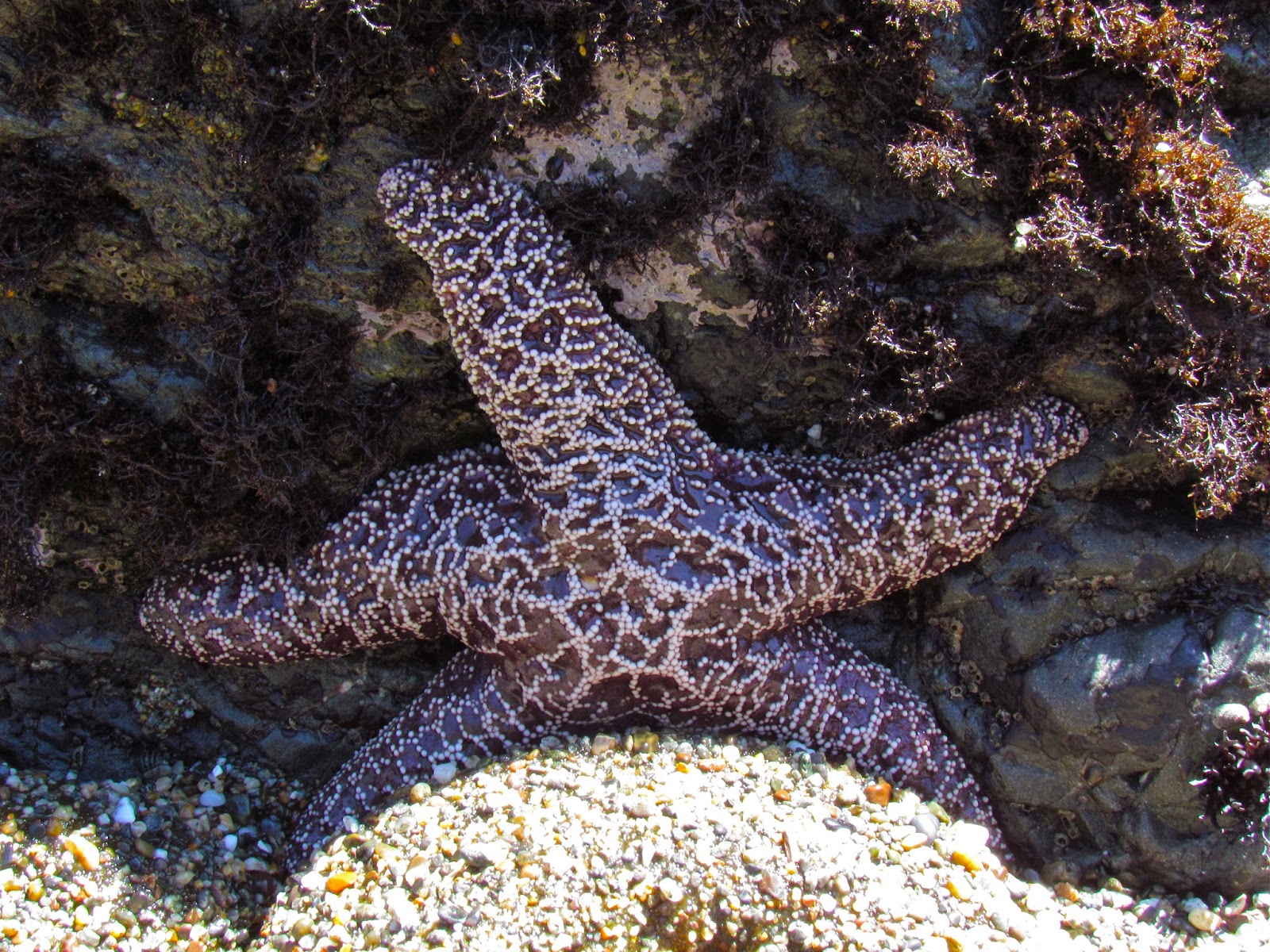
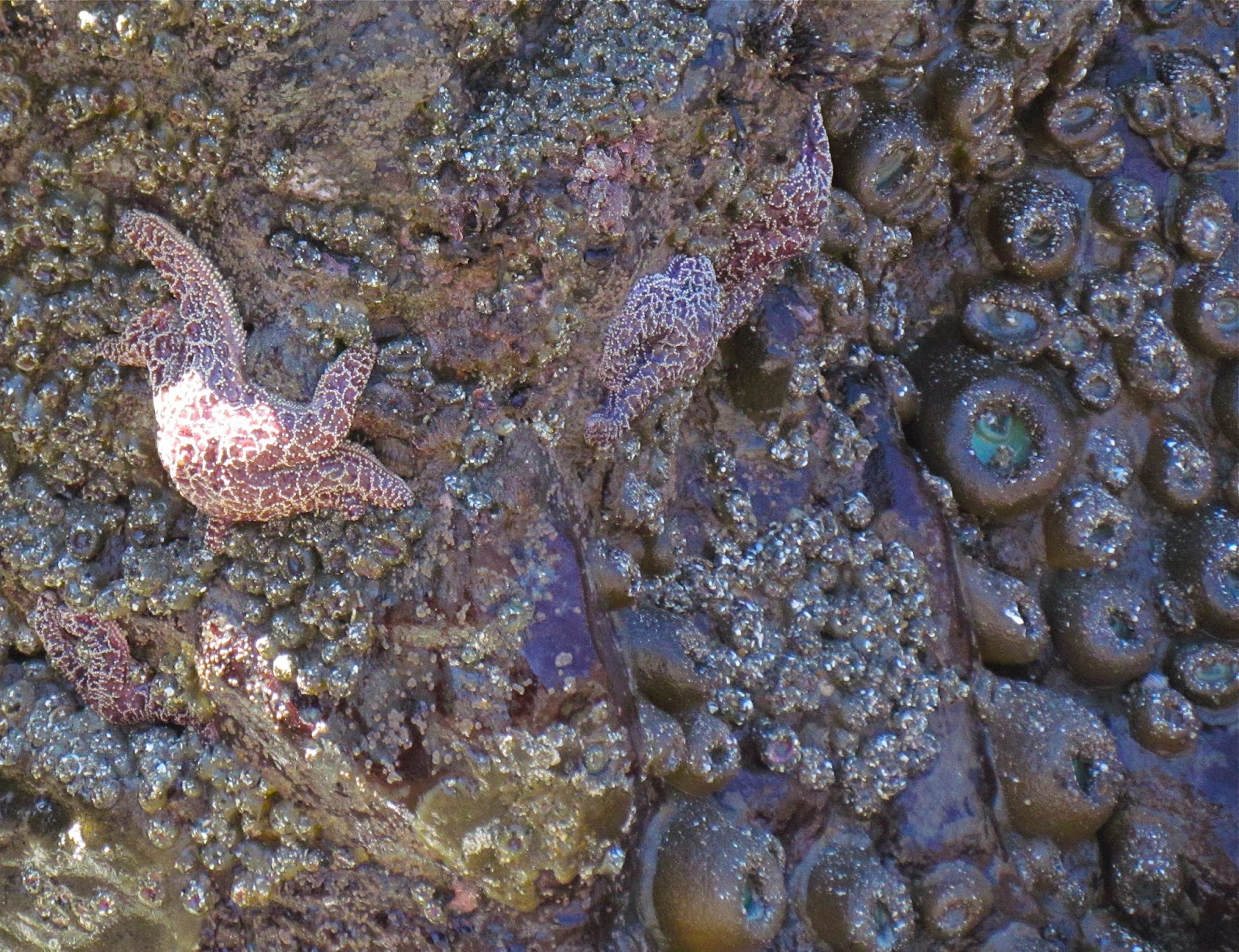
'Brimming Pools' is a featured article in National Geographic this month. Along with beautiful photographs by David Liittschwager, writer Mel White takes us on a journey of Bodega Head Tidepoos. Guided by Sarah Ann Thompson, a marine biologist from the Farallon Institute in Petaluma, White describes his experience: The rocks and pools here create an abundance of opportunities and host a diversity of life to rival any rain forest. Pisaster is just one of scores of species that have adapted to innumerable micro-habitats with a seemingly endless variety of physical shapes and lifestyles. One little worm can shoot a harpoon out of its head to stab its prey. A limpet tends and guards its own farm plot. A seaweed releases acid for defense when it's injured. A nudibranch (which looks like a gussied-up slug) eats poisonous creatures and implants stinging cells under its own skin to repel predators. Why all the aggression? It's simply the result of lots of plants and animals competing for resources in a highly productive but limited space. In nature, as in real estate, location is everything, and the intertidal zone is Park Avenue. White also gets an education about sea creatures from Erik Sanford, a biologist with the Bodega Marine Lab. White tells us:
So there's the magic. Eric Sanford is holding, in one hand, representatives of more than one-fourth of all the animal life on Earth: nine phyla on one rock. In comparison, the entire land surface of the planet, from Poles to Equator, is home to only about a dozen phyla.
Sanford is actually a little crestfallen because he can't find a peanut worm, an odd thing in the phylum Sipuncula that would give us an even ten. The thrill would have been strictly numerical, though. I've already seen a peanut worm, and it has all the aesthetic appeal of used chewing gum. (I must admit, however, that the one thing it does, it does very well: extending a hydraulically powered, tentacle-tipped proboscis several times the length of its body to grab tiny bits of drifting dead stuff. Sanford calls it "this crazy sort of Dr. Seuss-like thing.") This article is a great way to learn a bit more about our precious and unique coast. For more information contact the Bodega Marine Lab for a tour. Public drop in tours are available Fridays, 2-4 for groups less than 10 people.
Previously Unreleased track, 'Blue Sway' Written Nearly 20 Years Ago Dedicated to Linda McCartney . . .
'Blue Sway' music video
Paul McCartney recruited award-winning surf filmmaker Jack McCoy to create a music video for his previously unreleased track "Blue Sway." Written nearly 20 years ago, McCartney's never-before released song, "Blue Sway," is available for the first time on the bonus audio disc of the special edition of McCartney II. The music video created by McCoy is also featured on the bonus DVD included in the set. McCartney II will be released on June 14th by MPL and Concord Music Group.
Jack McCoy has been capturing the surfing vision in a truly unique way. Using a high powered underwater jet ski, the filmmaker found that he was able to travel behind a wave, creating underwater images that have never been seen before.
Over the past couple of years, McCoy set out to capture footage for his surf film, A Deeper Shade of Blue. During the editing process, McCoy put one of his surfing sequences to a song off McCartney's The Fireman album. A mutual friend, Chris Thomas, saw the footage while visiting McCoy in Australia, and when he returned to the UK he gave McCartney a copy of the sequence.
"Paul was pretty stoked with what I'd created. He immediately thought my images might be suitable to go with his unreleased song "Blue Sway." said McCoy.
McCoy spent the next six weeks creating the music video, while also working full days on making A Deeper Shade of Blue. McCoy compiled and edited footage that he filmed off Tahiti's Teahupoo reef to create what became the "Blue Sway" video.
"When I saw Jack McCoy's underwater surfing footage put to the soundtrack of "Blue Sway" I was blown away," said McCartney.
"Blue Sway" won 'Best Music Video' at NYC BE FILM Short Festival this past May, and the video will be featured as part of Surfrider Foundation's summer PSA campaign. Surfrider Foundation is a non-profit grassroots organization dedicated to the protection and enjoyment of our world's oceans, waves and beaches.
This guy was so much fun to watch! He went all-out - flying down the beach faster than I could shoot! He was obviously having a blast as evidenced by his hootin' and hollerin' . . . I should've shot a video but I got so caught-up in watching him I was just enjoying the moment and not thinking about much else. . .
Great informational messages about alternatives to plastic and rethinking plastic waste . . .
by Charles Moore, Founder of the Algalita Marine Research Foundation, onboard the Esperanza
Plastic is now everywhere. When locating plastics anywhere in the environment, scientists have little difficulty fulfilling the age-old saying, "Seek, and ye shall find."
But where do plastics come from? Most plastics are made from the natural gas portion of our petroleum resources. The gasses, like ethylene, are purified and turned into plastic by the use of polymer catalysts, which link ethylene molecules together to make polyethylene. Polyethylene plastics make water bottles, clothing fabric, and Tupperware as well as thousands of other products. So how does the polymer get to the processor who makes the goods for the consumer. The answer is “nurdles.” Over 250 billion pounds of nurdles are shipped around the world to plastic processing factories every year. Nurdles are plastic resin pellets that represent the most economical way to ship large quantities of a solid material, that is, in a pelletized form.
The pellets come in rail tank cars, and at 20-25,000 per pound, there are about a billion of them in each tanker. So many have escaped over the last half century during the transfer from rail car to factory by vacuum hoses, washing during rainstorms from rail sidings to the sea, that nurdles now represent about 10% of the litter counted on beaches worldwide.
In surface trawls for plastic particles aboard the Greenpeace vessel Esperanza, nurdles have been found in every trawl. The plastic industry itself is the biggest single source of plastic particles in the environment.